Knowledge Systems · Core text
Śrīmad Bhāgavatam
The Śrīmad Bhāgavatam (Bhāgavata Purāṇa) is a Sanskrit Purāṇa of about 18,000 verses in twelve books, centred on devotion (bhakti) to Viṣṇu and to Kṛṣṇa. Its tenth book, on Kṛṣṇa’s life, is among the most widely read works of Indian literature.
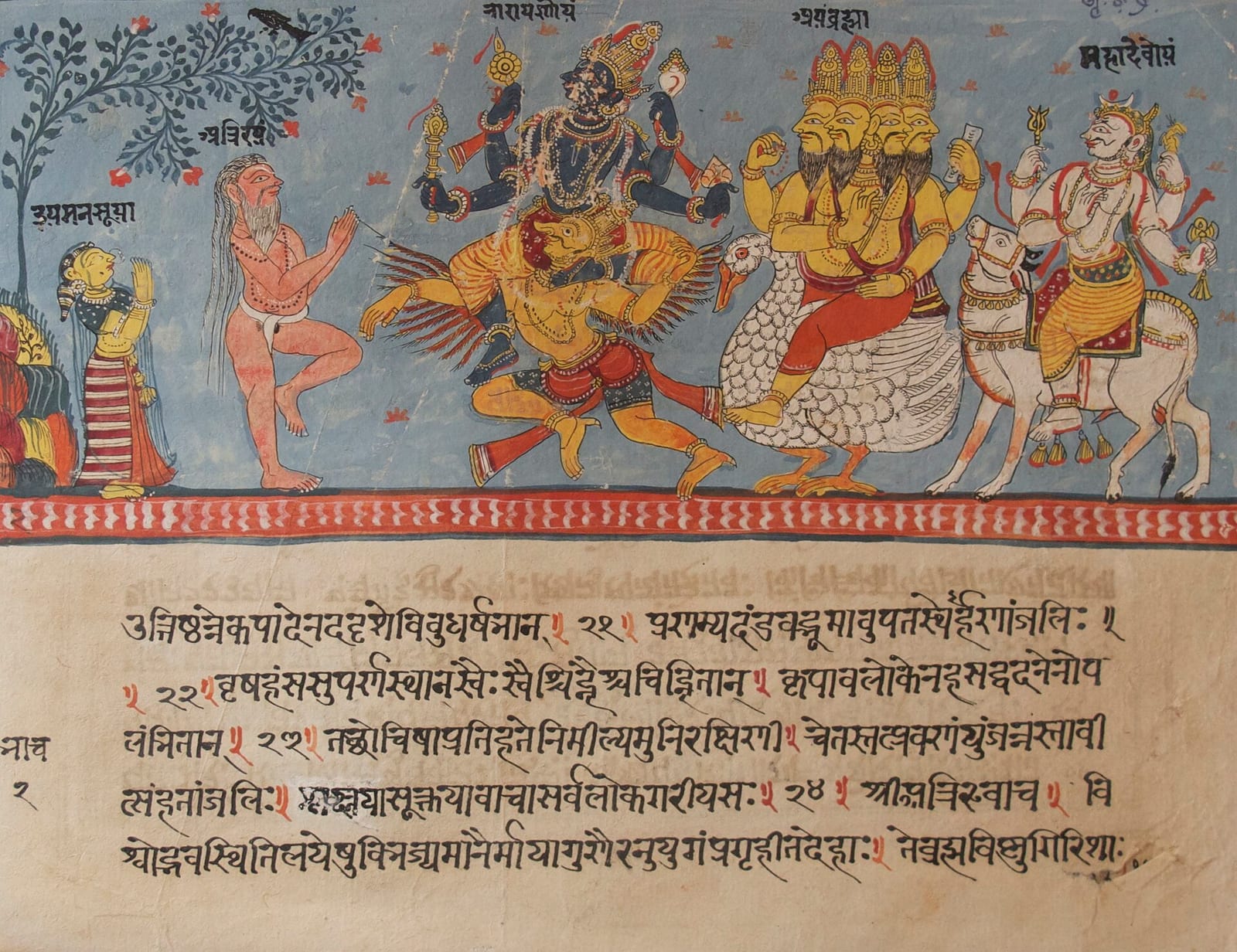
At a glance
Śrīmad Bhāgavatam in brief
| Language | Sanskrit |
|---|---|
| Genre | Purāṇa — one of the eighteen major Purāṇas (Mahāpurāṇas) |
| Structure | 12 books (skandhas), about 18,000 verses |
| Narration | Śuka speaks it to King Parīkṣit on the bank of the Gaṅgā, in the seven days before the king’s death; Sūta retells it to the sages of the Naimiṣa forest |
| Traditional author | Vyāsa |
| Date | Most scholars date the text as we have it to between the sixth and tenth centuries CE; tradition holds it to be far older |
| Classical commentary | Śrīdhara Svāmī’s Bhāvārtha-dīpikā (c. 14th century), followed by many later Vaiṣṇava commentaries |
| Also known as | Bhagavata Purana, Bhāgavata Purāṇa, Srimad Bhagavatam, Bhagavatam |
What the Bhāgavatam is about
King Parīkṣit, grandson of Arjuna, learns that he will die in seven days. He sits by the Gaṅgā and asks the sage Śuka what a person should do — above all, one who is about to die. The Bhāgavatam is Śuka’s answer: an account of creation, of the avatāras of Viṣṇu, of kings, sages and devotees, and finally of Kṛṣṇa’s life, all leading to devotion as the heart of a good life.
Key ideas
Among the ideas and passages most often studied:
- Bhakti
- Loving devotion as the highest aim — open to anyone, whatever their birth, learning or circumstances.
- The avatāras
- Viṣṇu’s descents, among them Matsya, Kūrma, Varāha, Narasiṃha, Vāmana, Rāma and Kṛṣṇa.
- Lives of devotees
- Dhruva, Prahlāda, Gajendra and Ambarīṣa — stories of steadiness, courage and surrender.
- Teachings within the text
- Kapila’s teaching to Devahūti (Book 3) and the Uddhava Gītā (Book 11), Kṛṣṇa’s final instruction to his friend Uddhava.
Its influence
The Bhāgavatam has shaped devotional traditions across India — including the Vaiṣṇava tradition of Śrī Caitanya in Bengal — and has inspired poetry, music, dance and painting for centuries; the picture of Kṛṣṇa lifting Mount Govardhana on TUTOR’s course pages comes from a seventeenth-century illustrated Bhāgavata Purāṇa.
Structure
The twelve books
The Bhāgavatam moves from questions about how to live and die well, through creation and the histories of kings and sages, to the life of Kṛṣṇa and the end of the age:
| Book | Skandha | What it covers |
|---|---|---|
| 1 | Prathama | The setting: the sages’ questions, Vyāsa and Nārada, Parīkṣit’s curse and his meeting with Śuka |
| 2 | Dvitīya | Śuka begins: the universal form, creation, and the essence of the teaching |
| 3 | Tṛtīya | Vidura’s journey, Maitreya’s account of creation, Varāha, and Kapila’s teaching to his mother Devahūti |
| 4 | Caturtha | Dakṣa’s sacrifice and Satī, Dhruva, King Pṛthu, and the Pracetās |
| 5 | Pañcama | Priyavrata, Ṛṣabha and Bharata; the shape of the universe |
| 6 | Ṣaṣṭha | Ajāmila, Dakṣa’s descendants, Vṛtra and Citraketu |
| 7 | Saptama | Prahlāda, Hiraṇyakaśipu and Narasiṃha; the duties of the stages of life |
| 8 | Aṣṭama | The ages of the Manus, Gajendra, the churning of the ocean, Vāmana and Bali, Matsya |
| 9 | Navama | The solar and lunar dynasties, Ambarīṣa, and Rāma’s story in brief |
| 10 | Daśama | The life of Kṛṣṇa — Vraja, Mathurā and Dvārakā |
| 11 | Ekādaśa | The Uddhava Gītā, Kṛṣṇa’s last teaching, and the end of the Yādavas |
| 12 | Dvādaśa | The age of Kali, Parīkṣit’s passing, Mārkaṇḍeya, and a summary of the whole |
Questions
Questions people ask about the Srimad Bhagavatam
How many verses does the Śrīmad Bhāgavatam have?
About 18,000 verses in twelve books (skandhas).
Who narrates the Bhāgavatam?
The sage Śuka narrates it to King Parīkṣit; Sūta retells that narration to the sages of the Naimiṣa forest.
Is the Bhāgavatam the same as the Bhagavad Gītā?
No. The Gītā is a 700-verse dialogue within the Mahābhārata; the Bhāgavatam is a separate and much longer Purāṇa. Both are attributed to Vyāsa and both teach devotion to Kṛṣṇa.
Which part of the Bhāgavatam is read most?
The tenth book (Daśama Skandha), on the life of Kṛṣṇa.
What is the Uddhava Gītā?
Kṛṣṇa’s final teaching to his friend Uddhava, in the eleventh book of the Bhāgavatam.
How can I study the Bhāgavatam with TUTOR?
Through TUTOR’s Śrīmad Bhāgavatam course: a structured textual and reflective study connecting reading and understanding to practice in the learner’s own life. The course page shows its formats and fees.
Study it with TUTOR
Studying it with TUTOR
TUTOR’s Śrīmad Bhāgavatam course is a structured textual and reflective study — reading, understanding, application, practice and integration — with the same principle as the Gītā course: learning is connected to reflection, practice and integration in the learner’s own life at every level.
More core texts
TUTOR’s reference pages on the texts studied in Knowledge Systems.