Knowledge Systems · Core text
Śrīmad Bhagavad Gītā
The Bhagavad Gītā is a 700-verse Sanskrit dialogue in 18 chapters, set within the Mahābhārata on the battlefield of Kurukṣetra: Kṛṣṇa answers Arjuna’s crisis about duty, action and the self. It is one of the most widely read texts of Indian philosophy.
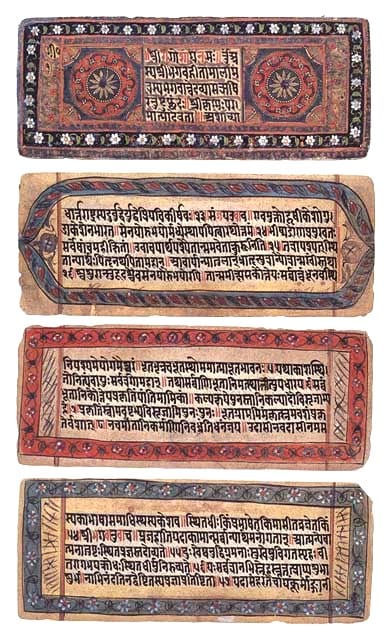
At a glance
Śrīmad Bhagavad Gītā in brief
| Language | Sanskrit verse, mostly in the anuṣṭubh (śloka) metre |
|---|---|
| Where it appears | The Bhīṣma Parva, the sixth of the Mahābhārata’s eighteen books |
| Structure | 18 chapters (adhyāyas), 700 verses (ślokas) |
| Speakers | Kṛṣṇa and Arjuna; Sañjaya narrates the dialogue to the blind king Dhṛtarāṣṭra |
| Traditional author | Vyāsa, to whom the Mahābhārata is attributed |
| Date | Scholars usually place its composition in the last centuries BCE; tradition sets the dialogue at the start of the Kurukṣetra war |
| Classical commentaries | Śaṅkara (Advaita, 8th century), Rāmānuja (Viśiṣṭādvaita, 11th–12th century), Madhva (Dvaita, 13th century); Jñāneśvar’s Marathi Jñāneśvarī (1290) |
| Also known as | Bhagavad Gita, Gita, Gītā, Gitopanishad |
What the Gītā is about
Two armies of one family face each other at Kurukṣetra. Arjuna, the greatest archer of the Pāṇḍavas, sees teachers, cousins and friends on the other side and lays down his bow. Kṛṣṇa, his friend and charioteer, answers him — and the answer moves from the immediate question, whether to fight, to the larger ones: what the self is, how to act without being bound by action, and how to live in relation to the divine.
The Gītā opens with the blind king Dhṛtarāṣṭra asking Sañjaya what is happening on the field; everything after is Sañjaya’s report of the dialogue. The dialogue ends with Arjuna saying that his confusion is gone and that he will do as Kṛṣṇa says.
Key ideas
A few ideas run through the whole text and are the ones most often studied:
- Dharma
- Action that fits one’s place, role and the order of things; the Gītā begins at the moment when Arjuna can no longer see his.
- Karma yoga
- Acting fully while letting go of a claim on the results — set out in chapters 2 and 3 and returned to throughout.
- The self (ātman)
- Unborn and undying, not destroyed when the body is (chapter 2); the basis of the Gītā’s steadiness in loss and gain.
- Paths of yoga
- Action (karma), knowledge (jñāna), meditation (dhyāna) and devotion (bhakti) — presented as complementary, with devotion given a special place.
- Steady wisdom
- The sthitaprajña, the person whose understanding stays firm in pleasure and pain, success and failure (2.54–72).
- The three guṇas
- Sattva, rajas and tamas — qualities that colour action, food, faith, giving and knowledge (chapters 14, 17 and 18).
Reading it today
The Gītā has been read as philosophy, as scripture and as practical guidance, and commented on by every major school of Vedānta. Its questions — how to act well under pressure, how to work without being ruled by outcomes, how to stay steady in success and failure — are why it is read far beyond the tradition it comes from.
Structure
The eighteen chapters
Each chapter is named as a yoga — a discipline or way of seeing. The traditional names, their meaning and the number of verses:
| Chapter | Name | Verses |
|---|---|---|
| 1 | Arjuna Viṣāda Yoga — Arjuna’s despondency | 47 |
| 2 | Sāṅkhya Yoga — knowledge of the self | 72 |
| 3 | Karma Yoga — the discipline of action | 43 |
| 4 | Jñāna Karma Sannyāsa Yoga — knowledge, action and renunciation | 42 |
| 5 | Karma Sannyāsa Yoga — renunciation of action | 29 |
| 6 | Dhyāna Yoga — meditation | 47 |
| 7 | Jñāna Vijñāna Yoga — knowledge and realisation | 30 |
| 8 | Akṣara Brahma Yoga — the imperishable | 28 |
| 9 | Rāja Vidyā Rāja Guhya Yoga — the royal knowledge, the royal secret | 34 |
| 10 | Vibhūti Yoga — divine manifestations | 42 |
| 11 | Viśvarūpa Darśana Yoga — the vision of the universal form | 55 |
| 12 | Bhakti Yoga — devotion | 20 |
| 13 | Kṣetra Kṣetrajña Vibhāga Yoga — the field and its knower | 34 |
| 14 | Guṇa Traya Vibhāga Yoga — the three guṇas | 27 |
| 15 | Puruṣottama Yoga — the supreme person | 20 |
| 16 | Daivāsura Sampad Vibhāga Yoga — divine and demonic qualities | 24 |
| 17 | Śraddhā Traya Vibhāga Yoga — the three kinds of faith | 28 |
| 18 | Mokṣa Sannyāsa Yoga — freedom through renunciation | 78 |
Verse counts follow the standard 700-verse text; some editions count 35 verses in chapter 13.
Questions
Questions people ask about the Bhagavad Gita
How many chapters and verses does the Bhagavad Gītā have?
Eighteen chapters and 700 verses in the standard text (some editions count one more verse in chapter 13).
Where does the Bhagavad Gītā appear?
In the Bhīṣma Parva, the sixth book of the Mahābhārata, just before the Kurukṣetra war begins.
Who speaks in the Gītā?
Mostly Kṛṣṇa, answering Arjuna. Sañjaya narrates the dialogue to King Dhṛtarāṣṭra, who speaks the first verse.
What does “Bhagavad Gītā” mean?
“The Song of the Blessed One”: Bhagavān is the Blessed Lord, and gītā means song.
What is karma yoga?
The discipline of acting fully while letting go of a claim on the results of action, set out mainly in chapters 2 and 3.
How can I study the Bhagavad Gītā with TUTOR?
Through TUTOR’s Śrīmad Bhagavad Gītā course, which follows a cycle of study, understanding, reflection, application, practice, review and integration. The course page shows its formats and fees.
Study it with TUTOR
Studying it with TUTOR
TUTOR’s Śrīmad Bhagavad Gītā course is a structured study of the text with an explicit life-application cycle: Study → Understand → Reflect → Apply → Practise → Review → Integrate. Each level connects study and understanding to reflection, practice and integration in the learner’s own life.
More core texts
TUTOR’s reference pages on the texts studied in Knowledge Systems.